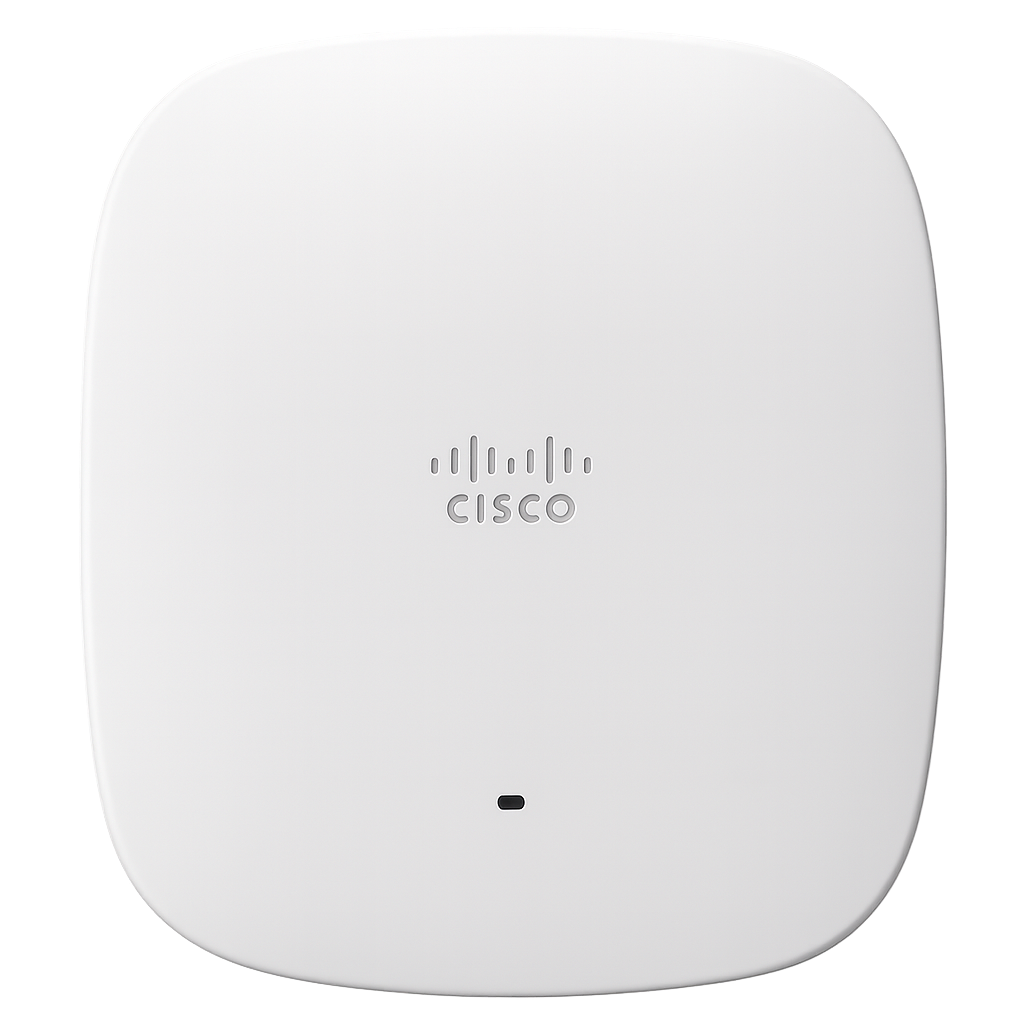
CW9176I-B
Intelligent Wi-Fi 7 for higher density, greater performance, and simpler operations.
A decision-oriented Wi-Fi 7 briefing for UF: technology update, arena strategy, higher-ed references, portfolio analysis, trade-in, licensing, and the Cisco roadmap.
NaviGator delivers AI to every student device — a workload that did not exist when O'Connell's Wi-Fi 5 hardware was specified in 2017.
One device, three radios working in parallel — 2.4 + 5 + 6 GHz at the same time. Three highways instead of one. When tipoff hits and 12,000 phones open the same app in the same second, the device keeps streaming because if one band saturates, packets flow on the other two.
Intelligent Wi-Fi 7 for higher density, greater performance, and simpler operations.
Use multiple bands at once for lower latency, higher reliability, and faster application performance.
Simultaneous 2.4 + 5 + 6 GHz for each device. Bandwidth aggregation + instant band failover — no controller round-trip.
Wider channels deliver more capacity and better efficiency across Wi-Fi 7 client devices.
Double the highway width vs Wi-Fi 6/6E's 160 MHz max. More spectrum, more simultaneous throughput.
Pack more data into every transmission for meaningful gains in throughput in clean RF conditions.
4,096 amplitude/phase states vs 1,024 in Wi-Fi 6. ~20% throughput uplift in clean RF environments.
Efficient scheduling with smarter airtime use for hundreds of users and devices.
Smarter airtime slicing among many small clients simultaneously. No rationing, no head-of-line blocking.
10,000 APs · 1,344 switch stacks · 14 WLCs · 30 buildings. The control plane is already Wi-Fi 7-ready; the urgency lives in the access layer's lifecycle window. 99.6% of the fleet enters refresh cycle within 5 years — and 78.2% just hit Cisco's EOL15855 bulletin in March/2026.
Controller and code are green. The three blockers concentrate in one layer — the access switch. Everything else is either provisioned, audit-able, or a clean refresh.
A 32 000-seat venue. Mixed workloads — guest streaming, point-of-sale, IoT, broadcast. One ceiling.
The Arena is not just a high-impact venue — it is the highest-leverage scoped pilot UF can choose. Mixed workloads (guest streaming, point-of-sale, IoT, broadcast), proven event-blackout discipline, and a clean A/B baseline.
Every one of the nine access switches feeding O'Connell is a Catalyst 2960-X. PoE+ 30 W. 1 G uplinks. Classic IOS 15.x. An AP refresh without a switch refresh leaves Wi-Fi 7 at half-throttle.
Five topics, one decision. The chassis under the floor is the chassis that decides what Wi-Fi 7 can actually do here. UFIT × Cisco read-in · 2026-05-23
Adjacent venues follow the same pattern at different scales. Florida Gymnasium — 97 APs, all Wi-Fi 5, all on 2960-X uplinks — is the Phase 1B follow-on. Ben Hill Griffin Stadium — 9 APs, under-deployed — is a separate expansion engagement, not part of this roadmap's Phase 1.
The exit window is narrow but clean. Cisco's EOS notice c51-744432 retires the 2960-X family; pre-basketball Summer 2026 is the only no-blackout cutover window the venue can absorb. BOM lock is required 31-90 days in advance.
The replacement matrix is concrete — every zone has a target SKU and a corresponding switch refresh. The adjacency map shows what is added vs leveraged, and where the visibility lives.
| Zone | APs today | Recommended Wi-Fi 7 AP | Count | Switch refresh? |
|---|---|---|---|---|
| O'Connell Bowl | 142 (3802P/I) | CW9176I-B | 142 | 7 × 2960-X → 7 × C9300X-48HX |
| O'Connell Concourse | 32 | CW9176I-B | 32 | 5 × 2960-X → 5 × C9300X-48HX |
| O'Connell Office | 30 | CW9172I-B + CW9163E | 30 | 5 × 2960-X |
| O'Connell Press | 9 | CW9172I-B | 9 | Shared IDF |
| O'Connell Ticketmaster | 10 (9115AXI) | Defer — Wave 2 | 0 | n/a |
| Florida Gym (4 zones) | 97 (3802I) | CW9176I-B | 97 | 8 × 2960-X → 8 × C9300X-48HX |
| Ben Hill Griffin Stadium | 9 | Defer + expansion | 0 | Already C9300 |
| Pilot total | 0 APs | ~25 × C9300X-48HX |
Four publicly named Cisco Wi-Fi 7 deployments — covering Super Bowl-scale stadiums, championship sports events, multi-purpose arenas, and the direct higher-ed peer. UF would join a proven cohort, not chase a category.
World's first large-scale Wi-Fi 7 stadium rollout. 6 GHz with AFC. Built to absorb peak Super Bowl concurrency.
125th U.S. Open Championship across 191 acres. Wi-Fi 7 measured 4× faster in key venue zones — championship-week real load.
Closest scale twin to O'Connell's 310-AP pilot envelope. Southeast Asia's first Wi-Fi 7 sports & event venue.
Multi-year campus revamp — classrooms, dorms, stadiums. CIO publicly framed as "Wi-Fi 7 for the AI campus" — same thesis as Saira's NaviGator framing.
Cisco Sports & Entertainment surfaces additional NBA/NFL/NHL Wi-Fi 7 customers under NDA during the Readiness Assessment. Only third-party-verifiable validators are cited publicly. The pro-venue NDA bench is deep — Super Bowl LX is the published proof point.
Every retiring AP becomes a credit line on the new BOM. Cisco TMP stacks with EDU pricing — three line items shift the FY27 math.
Buy the entitlement that makes the policy graph work. Do not buy shelfware.
Four stages mapped to where the refresh happens, not when it ends. Cards 02–04 partition the 10,000-AP fleet by generation and class · FY2027 → FY2028.
O'Connell Center + Florida Gymnasium — the first venue UF will run on Wi-Fi 7.
Campus Wi-Fi 5 fleet outside the Arena pilot — AIR-AP 3802 / 2802 / 1852 / 1562 / 1815W / 1832I refresh.
Academic + research indoor Catalyst 9100 fleet in EOL15855 — high-density classrooms, labs, offices.
Residential wall-plate (C9105AXW EOL15855) + outdoor Wi-Fi 6 + stadium expansion — coordinated with Housing IT.
UF operates 3,308 switch chassis across 1,344 stacks. Per Cisco bulletins (EOL13603 · EOL15072 · EOL14994) and the Wi-Fi 7 PoE/uplink envelope, every access chassis falls into one of three lanes.
Why · 1G uplink ceiling · no mGig · PoE+ 30W cap on 2960-X/3850-24P-E.
LDoS clock · 2960-X Oct 2027 · 3850 Apr 2027 (1 unit past) · 3560-CX Apr 2029.
Target · C9300X-48HX → 802.3bt 90W + mGig 10G.
Why · PoE+ 30W can't deliver the 802.3bt envelope · UPOE 60W limits Wi-Fi 7 to dual-stream.
LDoS clock · no announced EoS — refresh is technical choice, not lifecycle obligation.
Target · line-card swap to 90W, or chassis swap to C9300X-48HX in Wave 2.
Why · 802.3bt 90W native · mGig 10G/25G uplink ready.
LDoS clock · no announced EoS — operate through lifecycle.
Target · these become the pilot anchors for Stage 01 (Arena + adjacent IDFs).
Each bar = months remaining to LDoS, capped at a 24-month horizon. Shorter bar = closer to the gate. The hatched bar overflows the scale — WS-C3850-24P-E is already past.
390 units · LDoS 2027-04-30 per Cisco EOL24865 (~11 months remaining). Covered by Cisco TAC support until that date. Natural refresh via TMP credit before LDoS — single TMP BOM bundling the 7,821 Wi-Fi 6 APs also in EoS Dec/2026 (EOL15855).
The TAC support window is service comfort, not security. All 6 SKU families crossed End of Vulnerability/Security Support between 4 and 31 months ago. No new CVE remediation lands on these devices — only bug acknowledgements until each LDoS date. The LDoS gate is the final cliff, not the first.
UF has already built the Wi-Fi 7 control plane and the AI back-end. The access layer between them — APs and the switches feeding them — is where the next 3-year capex story actually lives, and the Arena is the right place to prove it.